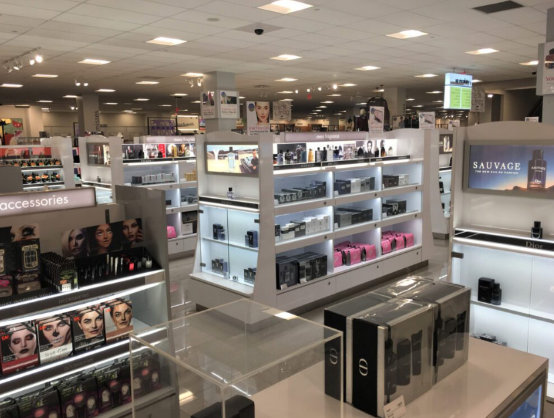
London retail has a specific problem that most brands operating here eventually confront. The store that looked distinctive when it opened starts to feel familiar — not just to returning customers but to the staff working in it daily. Familiarity breeds a particular kind of commercial invisibility. Shoppers stop noticing what they have already categorised, and a store environment that was once a reason to enter becomes part of the background noise of a busy street. The brands that avoid this cycle are not necessarily the ones with the largest spaces or the most prominent locations. They are the ones whose display environments were designed to do specific, considered work rather than simply hold stock attractively. Custom retail display solutions in London exist precisely at the intersection of brand identity and spatial intelligence.
Generic Fixtures Are a Brand Statement
The decision to fit out a retail space with standard fixtures is itself a communication – and not a neutral one. Off-the-shelf slatwall, uniform shelving, and standard gondola units carry an established visual vocabulary that shoppers read immediately and correctly. It says functional, undifferentiated, and primarily concerned with storage efficiency rather than experience. For brands whose commercial proposition depends on being perceived as distinctive, considered, or premium, this vocabulary actively contradicts the message being delivered through every other brand touchpoint. The display environment does not sit alongside brand identity — it either reinforces it or undermines it. There is no genuinely neutral middle position.
London Shoppers Read Environments Quickly
The concentration of retail choice in London — particularly across the independent and concept-store clusters that define areas like Marylebone, Shoreditch, and Covent Garden — means that shoppers here have developed unusually sophisticated environmental reading skills. They make entry decisions based on visual signals gathered in seconds from a pavement perspective. They categorise a brand’s positioning, quality level, and relevance to them before a single product has been consciously examined. Custom retail display solutions in London that are designed with this rapid environmental assessment in mind — with a considered entrance proposition, a clear spatial hierarchy, and materials that signal brand values immediately — are doing commercial work at the moment it matters most, before the customer has decided whether to stay.
Spatial Logic Drives Commercial Outcomes
The movement patterns of customers through a retail space are not random. They respond to visual cues, spatial compression and release, lighting differentials, and the positioning of display structures in ways that are well understood and consistently underutilised. A display architecture that draws customers past high-margin categories on the way to destination products, that creates genuine dwell moments around items that benefit from closer consideration, and that builds discovery into the journey rather than leaving it to chance, produces different commercial results from one that organises products logically from the brand’s operational perspective rather than from the customer’s experiential one. The difference between these two approaches is entirely a design decision, not a product or pricing one.
Materials Communicate Before Products Do
There is a sequence to how customers receive information in a retail environment that most display decisions ignore. Materials and finishes register sensorially and subconsciously before products are consciously examined. Solid timber, hand-finished metal, considered material transitions, and surfaces with genuine tactile quality communicate craft and permanence in ways that the products displayed on them inherit. Custom retail display solutions built from materials selected for brand alignment rather than procurement convenience create environments where the infrastructure reinforces the product story rather than creating a dissonance between what the brand claims to be and what the physical environment actually feels like. That alignment is one of the most persuasive things a retail environment can deliver, and it is achieved entirely through design decisions rather than marketing spend.
Adaptability Is a Design Requirement
London retail spaces change faster than the businesses occupying them often plan for. Seasonal campaigns, evolving product ranges, and shifting brand direction all create pressure on display systems that were designed for a fixed configuration. Custom display infrastructure built with genuine modularity — where sections can be reconfigured, heights adjusted, and graphic elements updated without structural replacement — protects the initial investment across multiple iterations rather than becoming obsolete when the brand moves forward.
Conclusion
The retail environments that hold their commercial effectiveness across seasons and years are not the ones that looked most impressive on opening day. They are the ones designed with genuine strategic intent from the beginning. Custom retail display solutions in London that address brand communication, spatial customer behaviour, material honesty, and adaptive flexibility produce environments that work harder and last longer than any standard fixture alternative. In a market as competitive and design-literate as London, that level of considered investment in the physical environment consistently separates the brands that grow from the ones that plateau.
